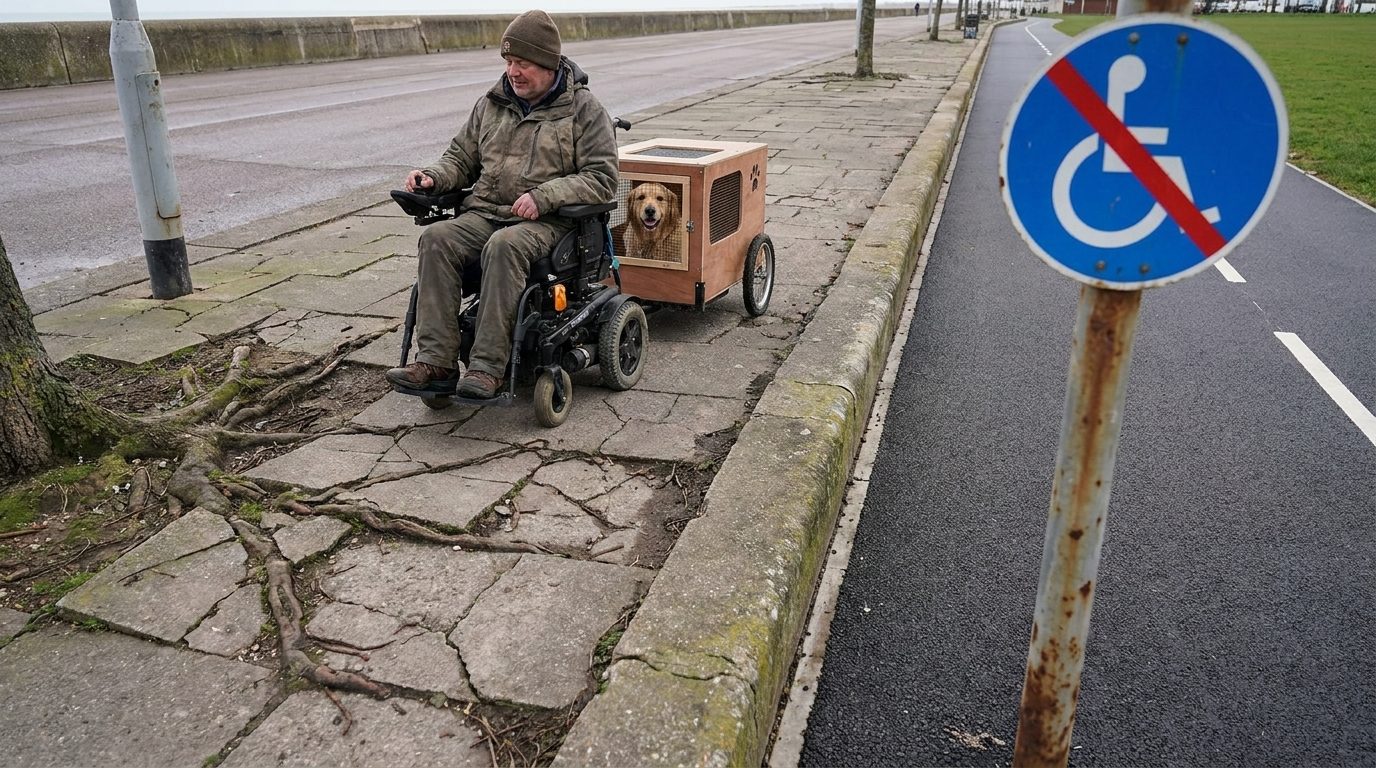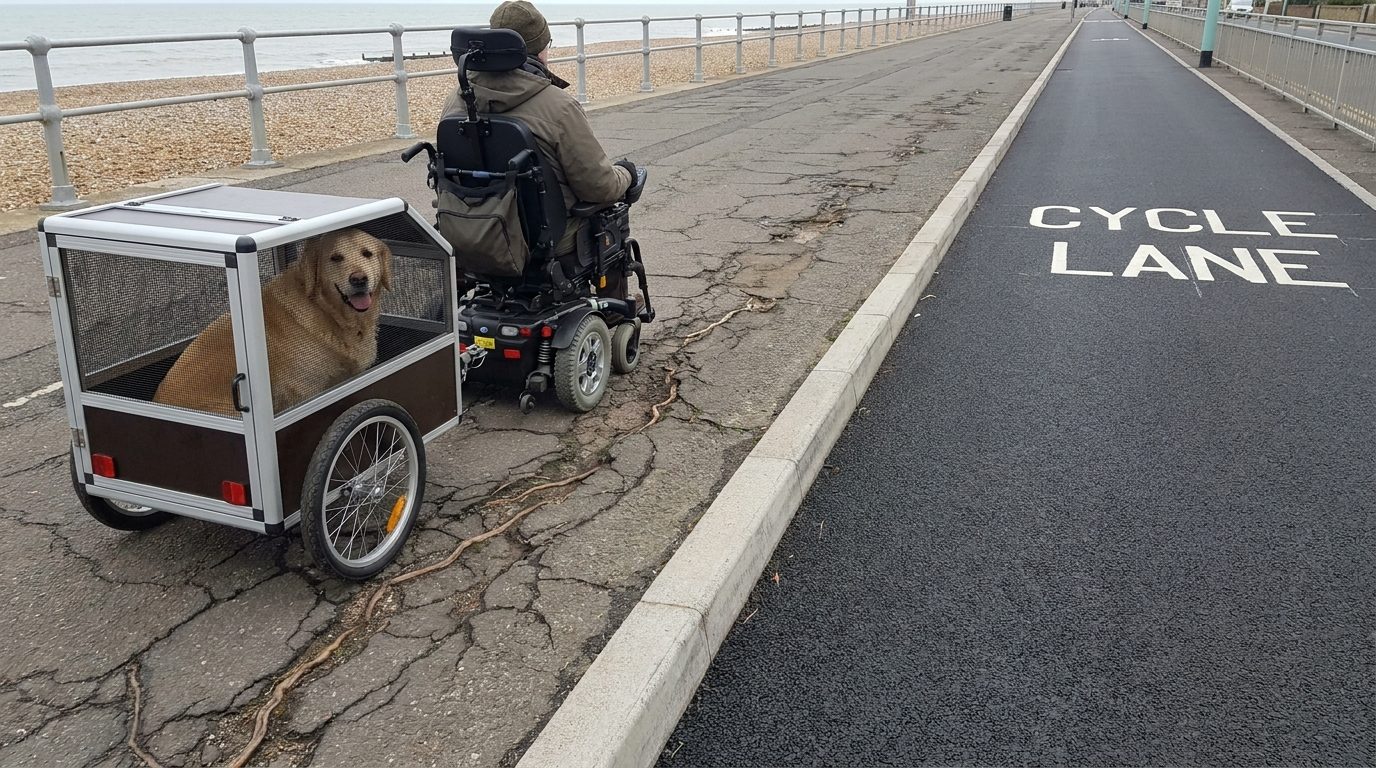
Let me begin with a confession. I have been trying, with the grim determination of a man who has been doing this for forty years, to find out which bits of Brighton & Hove I am legally allowed to travel on in my powered wheelchair. You might think this would be straightforward. You would be wrong. You would be spectacularly, magnificently wrong.
But I'm getting ahead of myself.
In Which Mike Oliver Explains Everything, Thirty Years Early
In 1993, Professor Mike Oliver, himself a wheelchair user who had not walked for more than thirty years, delivered his inaugural professorial lecture at the University of Greenwich. He called it "What's So Wonderful About Walking?"
It was, as these things go, a provocation. His central argument was simple and devastating: we do not punish non-flyers for not flying. On the contrary. We spend billions providing non-flyers with the most sophisticated mobility aids imaginable. They are called aeroplanes. And then we spend at least as much again building environments (runways, airports, terminal buildings the size of small cities) to make sure those mobility aids can actually function.
"Non-walkers are treated in exactly the opposite way. Environments are often designed to exclude us, transport systems that claim to be public continue to deny us access and when we protest, we are told there is no money."
Professor Mike Oliver, University of Greenwich, 1993Oliver was talking about walking in 1993. He could have been talking about cycling in Brighton & Hove in 2026. He simply had the wrong vehicle.
In Which Brighton & Hove Discovers Cycling and Forgets About Everything Else
Brighton & Hove City Council loves cycling. It loves cycling the way some people love a new hobby: with evangelical fervour, significant expenditure, and a tendency to talk about it at dinner parties to people who are quietly wondering if they can leave.
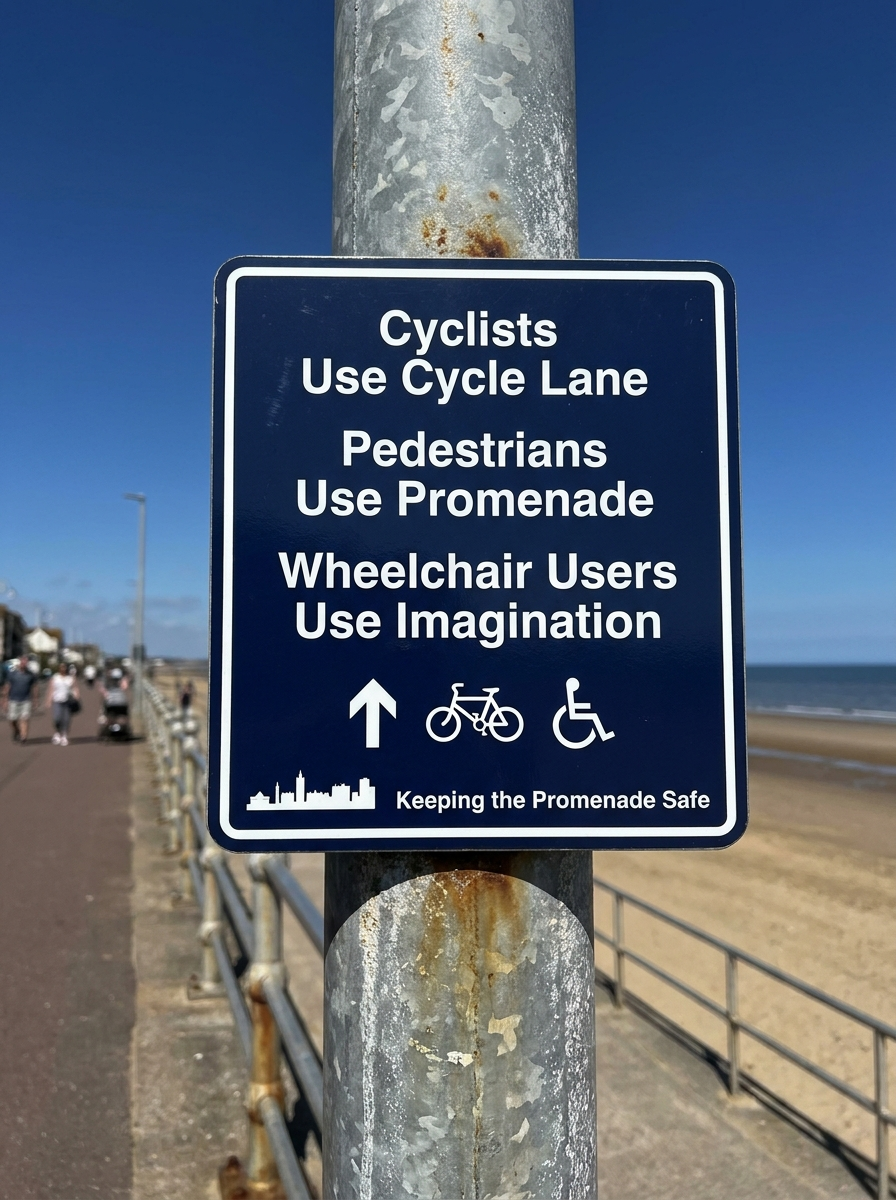
The council has produced a Local Cycling and Walking Infrastructure Plan, an LCWIP. It runs to many pages. It has maps, priorities, strategic routes, and a ten-year vision. It speaks warmly of "wheeling", which sounds inclusive, right up until the moment you try to use any of the infrastructure and discover that no one has told the infrastructure.
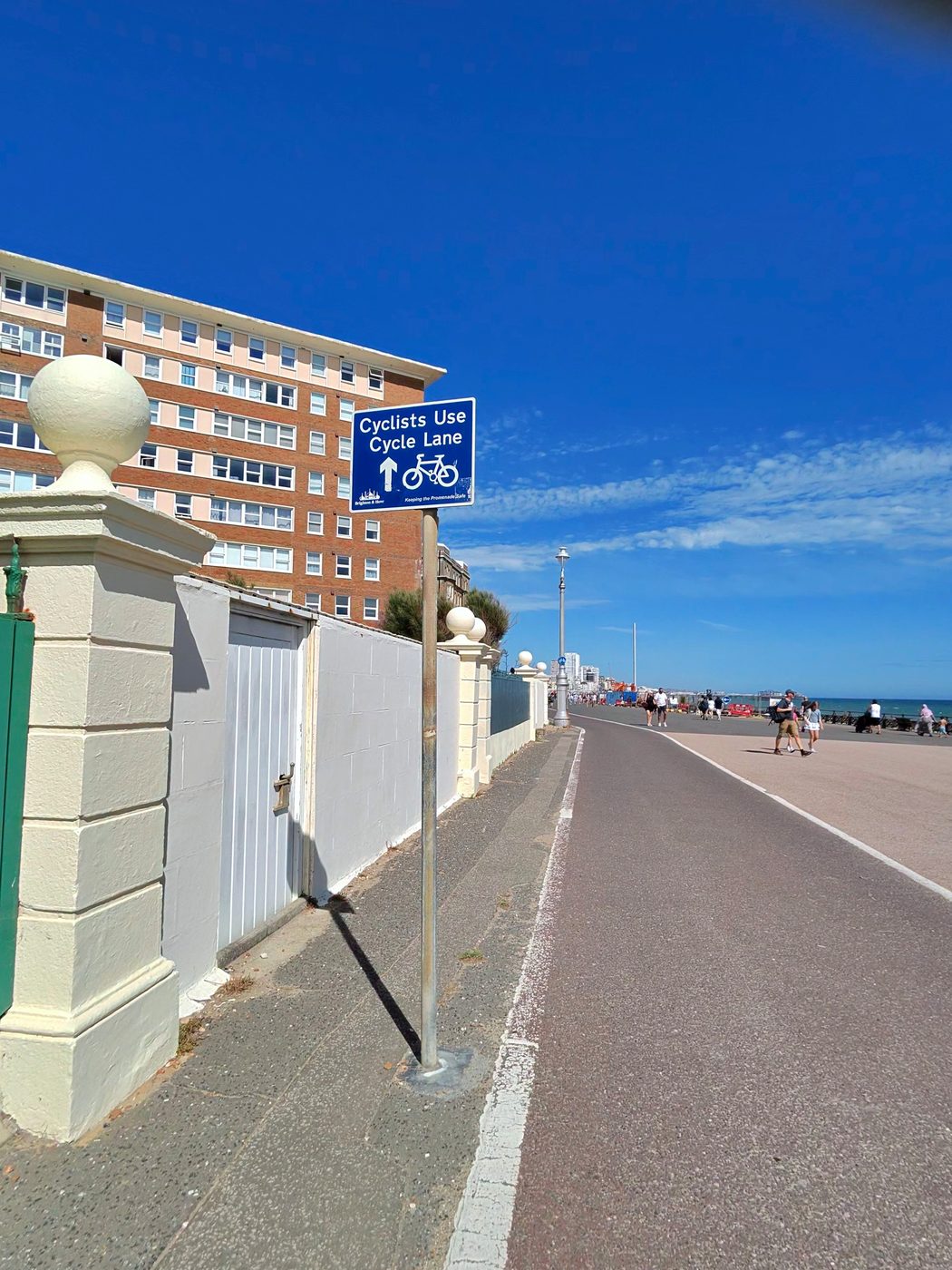
The A259 seafront (my seafront, the one I live near, the one disabled people have been using for decades) has received millions from Active Travel England for cycling improvements. Separated cycle lanes. On-road cycle lanes. A cycle map. Plans for more cycle lanes.
The pavement, meanwhile, has tree roots. Not metaphorical tree roots. Actual tree roots. The kind that have been heaving up the pavement surface for the better part of two decades while disabled people have been raising the alarm, attending consultations, writing letters, and being told, in the nicest possible way, that there is no money.
Oliver was right. We do not punish non-flyers for not flying. But in Brighton & Hove, we absolutely do punish non-cyclists for not cycling. We just dress it up as an active travel strategy and give it a logo.
In Which I Write a Perfectly Reasonable Letter and Receive a Perfectly Reasonable Non-Answer
I decided, being the sort of person who reads GOV.UK guidance for fun, to find out which of Brighton & Hove's cycling routes I am actually permitted to use. GOV.UK is admirably clear on this. Class 2 powered wheelchairs (pavement users, 4mph maximum) may use cycle tracks but not cycle lanes. A cycle track is physically separated from the road. A cycle lane is painted on the road. The distinction matters, legally, because a cycle lane is part of the carriageway, and Class 2 users are not supposed to be on the carriageway.
The Brighton & Hove Cycle Map, however, uses the categories: On Road Cycle Lanes, Separated Cycle Lanes, Off Road Cycle Tracks, and Shared Routes. Which of these is which, in legal terms? An excellent question. I wrote to the council to ask.
The response was, in many ways, an admirable document. It addressed the question of e-bikes. It discussed the proliferation of illegal e-mopeds. It offered safety advice about which side of quiet roads a Class 3 user might consider. It named two contacts I could approach for further advice.
What it did not do (not quite, not directly) was answer my question.
Matt had decided, somewhere in the drafting, that my question was really about Class 3, not Class 2. Class 2 users should be on the pavement, he reasoned. Therefore the question of cycle lanes versus cycle tracks does not apply to them.
This is a bit like answering the question "which bus stops are accessible for wheelchair users?" by saying "wheelchair users should use taxis." Logical, in a way. Helpful, in almost no way.
I am not blaming Matt. He responded. He was informative, within his chosen scope. He named contacts. He apologised, pre-emptively, if it was not the answer I had hoped for.
In Which Inclusivity Is a Condition of Funding, Which Raises Certain Questions
Here is an interesting fact. The Active Travel Fund (the pot of national money from which Brighton & Hove has received several millions for cycling infrastructure) requires schemes to comply with inclusive mobility guidance. It requires consultation with local communities, including harder-to-reach groups. It requires authorities to demonstrate that they have engaged broadly, in line with their Public Sector Equality Duty.
In other words: the council received money to build inclusive infrastructure on the explicit condition that it would be inclusive.
And then it built infrastructure that disabled residents cannot use, on routes alongside pavements that have been impassable in places for twenty years, following a plan that appears not to have asked, at any point, what happens to Class 2 powered wheelchair users when the pavement runs out.
I am not saying the money was taken under false pretences. I am simply noting that "inclusive" appears to mean different things to different people, and that one of those things, apparently, is "includes cyclists."
In Which Mike Oliver Is Proved Right Again
Oliver near the end of his lecture quoted Ken Davis: "We can elevate the act of walking to an importance higher than engaging in the struggle to create a decent society."
In 2026 in Brighton & Hove, we have elevated the act of cycling to an importance higher than engaging in the struggle to ensure disabled people can leave their houses.
The seafront is being made magnificent for cyclists. The cycle map is being refined. The LCWIP is being implemented, strategically and with vision. The e-scooter trial is coming, accompanied by an information campaign. And I am still trying to find out if I am allowed to use the path by the sea.
The answer, as best I can establish it, is: possibly, depending on which section it is, depending on whether that section meets the legal definition of a cycle track rather than a cycle lane, depending on whether the council's map terminology corresponds to the legal terminology (which, per the council's own officer, it does not always do) and depending on who you can find to ask.
Oliver's social model of disability tells us that disabled people are not disabled by our impairments. We are disabled by the barriers society builds and, crucially, the barriers it fails to remove. A crumbling pavement is a barrier. A missing dropped kerb is a barrier. A plan that spends millions making cycling more attractive while leaving wheelchair users to navigate legal uncertainty and heaving tree roots is a barrier.
These barriers do not build themselves. They are the product of a society that was designed without disabled people in mind, and a planning process that, despite the warm language of "wheeling" and "inclusivity," has not yet found it necessary to ask the most basic question:
Where exactly are powered wheelchair users supposed to go, and who, precisely, decided that was someone else's problem?
Still waiting for an answer. July 2026.Oliver asked in 1993: what's so wonderful about walking? I have a simpler question for 2026. What's so wonderful about cycling, and why, in a city that has spent millions answering that question, has no one got around to answering mine?